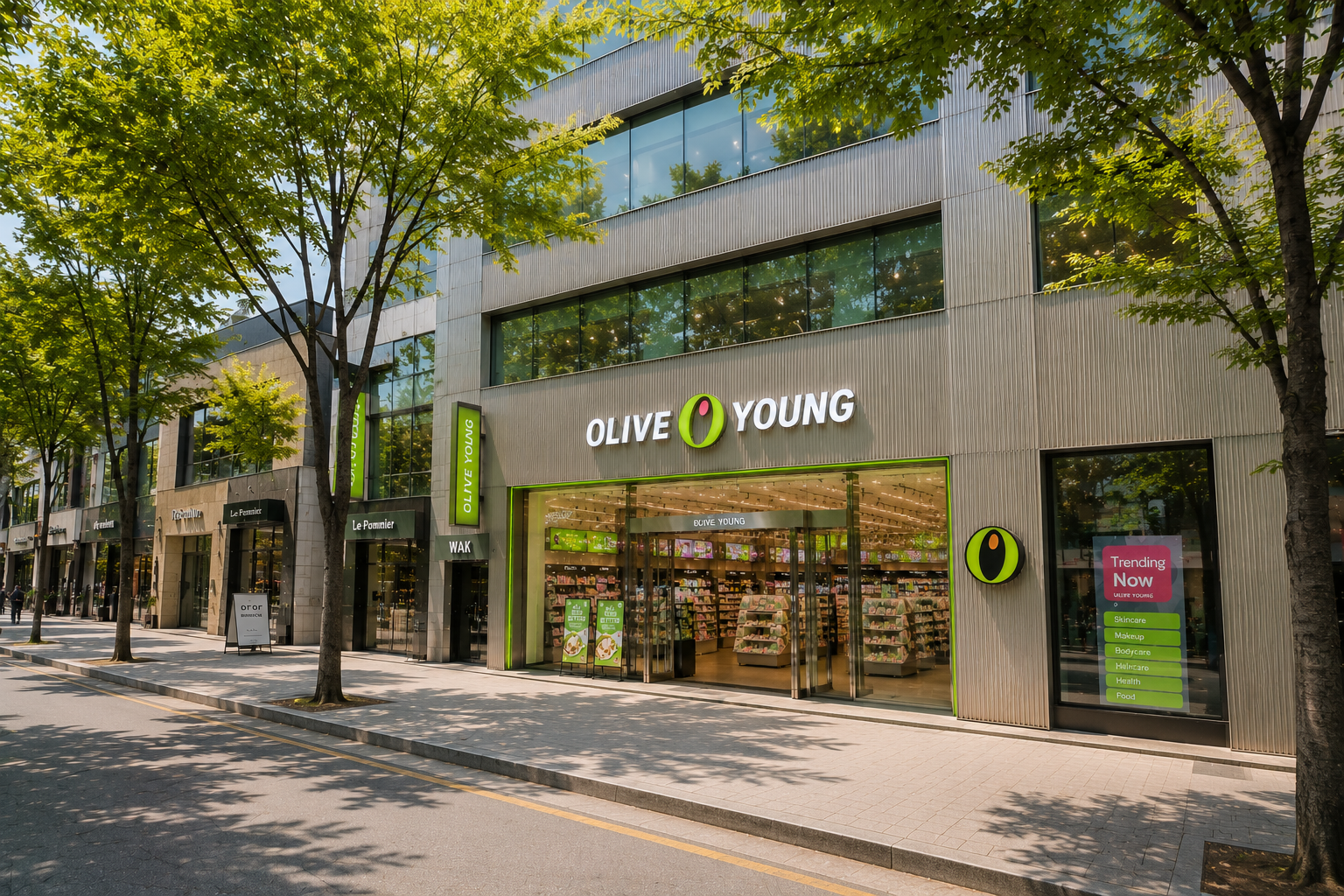
Olive Young rarely feels like a store where you buy just one thing. A single large branch can carry thousands of products, entire walls of sheet masks, dozens of near-identical sunscreens, and a promotion table stacked with 1+1 offers pulling your attention in every direction. Most visitors walk in with a vague idea and walk out with a basket that doesn't quite match it.
The problem usually isn't bad products — it's buying without a plan: too much of one thing, a product that doesn't suit your skin, or an entire routine committed to before you've tested a single item. This guide covers the method that avoids all three.
Quick Answer
The failure-proof version of Olive Young shopping is shorter than most guides make it sound:
● Pick one product category the night before (not three) and shortlist it down to two or three candidates.
● Read recent reviews and a few low-rated ones — not just the top “Recommended” reviews.
● Buy one item first. Test it during your trip. Repurchase later only if you actually like it.
● Skip full routines and oversized sets on your first visit — they're where most wasted money goes.
The rest of this guide fills in exactly how to do each step, plus where the real risk lies by product category, how much to budget, and the mistakes that quietly cost the most.
Research Before You Shop
Don't start comparing products while standing in front of the shelf. Twenty sunscreens with thousands of reviews and bestseller tags is not a moment for careful decision-making — it's a moment for guessing. Do the comparison the night before, somewhere quiet, and walk in already knowing what you're choosing between.
One small habit makes this much easier once you're in the store: save screenshots of specific products instead of trying to remember their names. Many Korean beauty product names are long, and most travelers discover products through Reddit, YouTube, or TikTok in the first place — showing a photo to a staff member or searching it in-app is faster than describing it from memory.
How the Shortlist Actually Comes Together
● Start from Olive Young's own bestseller lists, Reddit threads, YouTube reviews, or travel blogs — pick three candidates, not ten.
● If two look similar on paper, cut one. The goal isn't finding every option; it's making tomorrow's in-store decision take two minutes instead of twenty.
● Walk in comparing two products instead of twenty. That alone removes most of the decision fatigue that leads to impulse buying.
Which Review Sources Are Actually Worth Checking
| Source | What It's Good For | Limitation |
| Olive Young app/site reviews | Most relevant and accessible — start here for almost everything | Reviews skew toward domestic skin types and climate |
| International perspective — does it work in dry/humid climates, is it worth repurchasing abroad | Smaller sample size for less popular products | |
| Hwahae | Deeper ingredient and skin-type-specific breakdowns | Mostly Korean-language — use Papago or Google Lens |
| Naver Shopping | Large review volume, useful for cross-checking a specific claim | Mostly Korean-language, geared toward domestic shoppers |
For most tourists, Olive Young reviews plus a quick Reddit search is already enough. Save Hwahae and Naver Shopping for products you're genuinely unsure about.
How to Actually Read Reviews
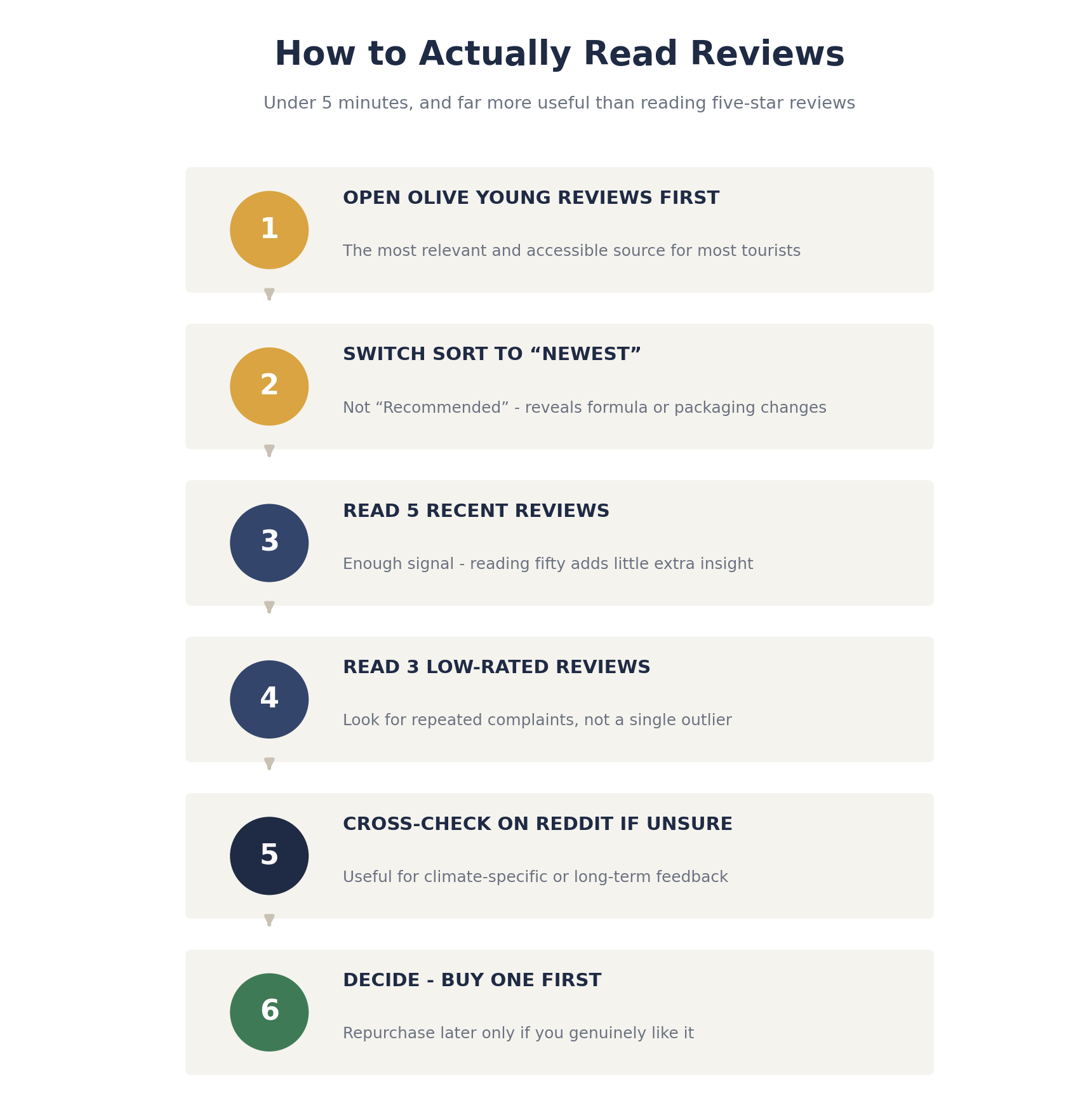
The whole process takes under five minutes and catches far more than reading five-star reviews alone.
Most people open reviews, read a few five-star ones, and buy. A slightly different order catches far more:
● Switch the sort from “Recommended” to “Newest” — this surfaces formula changes, packaging changes, and current experiences that older top reviews won't mention.
● Read five recent reviews. That's enough signal; fifty adds very little on top.
● Read three low-rated reviews specifically. One complaint about fragrance or white cast doesn't mean much. Ten people mentioning the same issue does.
● Ask a better question than “is this popular?” Ask why people like it, and just as importantly, why some people don't — that second answer is usually where the useful information is.
What to Buy Immediately vs. What to Research First
Not every product category carries the same risk. Some purchases are essentially foolproof; others depend entirely on your specific skin, and a bestseller tag won't tell you which side of that line a product falls on.
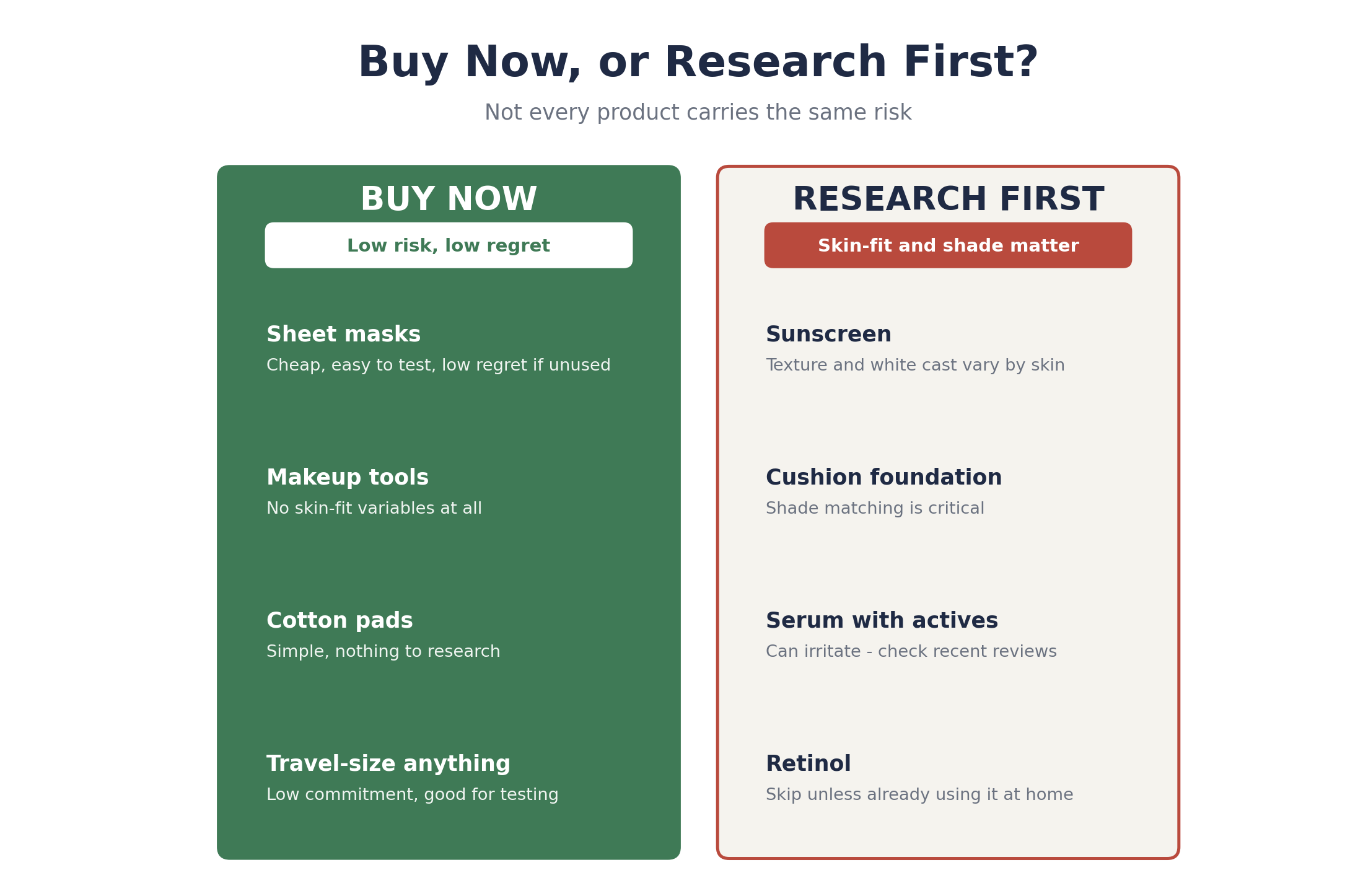
Low-risk purchases you can grab without much thought, versus categories worth a few minutes of research first.
| Category | Approach | Why |
| Sunscreen | Research and test first | Texture, white cast, and how it wears under makeup vary a lot by skin |
| Foundation (any format) | Research and test first | Color matching matters more than popularity — never buy on trend alone |
| Cushion foundation | Research, and test in person if possible | Shade matching matters more than popularity — a bestseller in the wrong shade helps no one |
| Serum (with active ingredients) | Research first | Actives can irritate; recent and low-rated reviews often flag this early |
| Retinol | Skip unless already using it at home | Travel isn't the ideal time to start a new retinol routine |
| Exfoliating products (acids, scrubs) | Research first | Easy to over-exfoliate on unfamiliar skin — especially risky if you don't know the active ingredient |
| Sheet masks | Buy now | Cheap, easy to test, low regret even if a pack goes unused |
| Makeup tools (puffs, brushes) | Buy now | No skin-fit variable — lightweight, affordable, easy to justify |
| Lip care | Buy now | Small, affordable, practical enough to use daily — low risk even as a gift |
Where and When to Shop
Not every traveler needs to visit the same branch. The right location usually comes down to whichever neighborhood is already on your itinerary that day — crossing the city specifically for Olive Young is rarely worth it.
| Area | Best For | Why |
| Seongsu | Beauty-focused travelers, best overall pick | Combines cafes, Seoul Forest, and beauty pop-ups — many visitors discover a brand at a pop-up, then compare or buy at Olive Young the same day |
| Gangnam | Travelers based south of the Han River | Pairs naturally with COEX, Starfield Library, Garosu-gil, and Apgujeong; generally less crowded than Myeongdong |
| Myeongdong | First-time visitors, easiest default | Multiple locations, strong tourist infrastructure, hard to get wrong |
| Hongdae | Anyone already spending the evening there | No reason to cross the city — shop wherever your day already takes you |
Best Time to Shop
● For the best product selection: shop earlier in the day. Popular items can sell out in busy tourist districts, and mornings through early afternoon generally offer the fullest shelves.
● For a calmer experience: avoid the evening rush, particularly after dinner in Seongsu, Gangnam, and Myeongdong, when stores get noticeably more crowded.
● For your trip overall: the middle of your trip beats the first or last day — early enough to return if you spot something else, and early enough that a luggage-space surprise doesn't happen the night before your flight.
Getting the Best Value
How the Sales Actually Work
A recurring “Olive Young Day” promotion runs around the 25th-27th of every month, and larger seasonal “Big Sale” events run for about a week each quarter, roughly in March, June, September, and December. But most experienced shoppers don't plan a trip around these dates — they visit because they already intended to buy something, and the sale happens to reduce the cost.
Outside of those windows, discounts are still common: sale tags, 1+1, and 2+1 promotions run on a rotating basis year-round. When you walk into a large branch, head to the promotion section before wandering the rest of the store — many visitors do this in reverse and only discover it after half an hour of browsing at full price.
The 1+1 / 2+1 rule of thumb: these bundles are excellent value for something you already planned to buy, and wasted money for something you didn't. A good deal on a product you'll never finish isn't a good deal.
Olive Young vs. Duty Free
A common mistake is postponing all beauty shopping until the airport. Two hours before a flight isn't a good moment to compare products, prices, and luggage space all at once.
● Choose Olive Young for: Korean skincare, sheet masks, everyday beauty products, a wider range of options, and the time to actually compare products side by side.
● Choose duty free for: luxury beauty brands, luxury fragrances, and last-minute replacement purchases if something ran out.
For most travelers focused on Korean beauty specifically, Olive Young remains the stronger shopping experience — duty free is a backup, not the main event.
What's Actually Cheaper in Korea
Not everything at Olive Young is meaningfully discounted compared to buying it at home — it depends on where the product is made and how widely it's already distributed.
● Usually worth buying here: Korean skincare, Korean sunscreen, sheet masks, Olive Young exclusive products, and travel-size beauty items — the categories most people specifically come to Olive Young for.
● Not always the best deal: imported brands, international luxury cosmetics, and other globally distributed products. If something is already sold widely in your home country, it's worth a quick price comparison before buying multiples.
Tourist Shopping Habits vs. Korean Shopper Habits
This is a pattern, not a rule — plenty of Korean shoppers buy on impulse too, and plenty of tourists already shop carefully. But the general contrast is common enough to be worth naming, because closing even part of the gap is where most of the savings in this guide come from.
| Tourist Shopper | Korean Shopper |
| Finds a product in-store | Researches before visiting |
| Reads only the top reviews | Reads multiple review types, including recent and low-rated ones |
| Buys immediately | Compares options first |
| Buys a full routine at once | Starts with one product |
| Buys in large quantities | Tests before buying more |
Real Shopping Scenarios
First Visit, Completely Overwhelmed
Everything looks interesting and every shelf has products you've seen online somewhere. Pick two categories only — sunscreen and sheet masks, for example — and ignore everything else. Photograph anything else that catches your eye and research it later rather than deciding on the spot. Leave room for a second visit.
Shopping for Gifts
Skip highly specific skincare — you don't know the recipient's skin type, sensitivities, or preferences. Sheet masks, cotton pads, and makeup tools are lower-risk gifts that almost anyone can use without a fitting problem.
Short on Time
Set a hard limit of 30-45 minutes. Head to the promotion section first rather than wandering the whole store, and stick to one or two categories. A time limit does more to prevent overspending than willpower alone.
Last Day of the Trip
This is when the worst purchases tend to happen — tired, rushed, thinking about packing, and surrounded by discounts. Use the last-day visit to buy more of what you've already tested and liked, not to experiment with something new.
K-Beauty Beginner
Don't build a full routine on day one. Pick a single category, make one good decision, and decide afterward whether you actually need anything else. Most K-beauty enthusiasts you're trying to shop like didn't build their routine in a single visit either.
Sensitive Skin
Test in person whenever a tester is available, and specifically read low-rated reviews looking for mentions of irritation, stinging, or breakouts. Avoid starting anything with strong actives (retinol, high-percentage acids, strong exfoliants) that you haven't already used at home.
How to Make the Actual Decision
● Don't trust a bestseller tag on its own — it tells you a lot of people bought something, not that it suits your skin, texture preference, or routine.
● A product trending on social media is useful for discovery, not for decision-making — treat it as a starting point to research, not a reason to buy.
● Match ingredients and product type to your actual skin type, not the skin type of the person who posted about it online.
● Use in-store testers whenever they're available, especially for cushion foundation, sunscreen finish, and anything with fragrance.
The Three-Visit Strategy
If your trip includes more than one Olive Young visit — most itineraries pass at least two or three branches without planning to — spreading purchases across visits instead of front-loading everything on day one avoids most regretted purchases.
● First visit: research, test, and buy small quantities only — one sunscreen, one moisturizer, a sheet mask or two.
● Second visit: buy more of what you've already tried and genuinely liked. Skip anything that turned out to be a miss.
● Last visit: buy backups and gifts — by now you know exactly what's worth repurchasing, so this trip has the least guesswork.
What's Worth Buying — and What You'll Regret
A useful filter for the display tables and promotion shelves: is this practical to travel with, not just popular online? The best purchases tend to be easy to pack, easy to use, easy to gift, or genuinely hard to find at home — not necessarily whatever has the biggest social media following.
● The sheet mask trap: a handful of masks makes a great, lightweight souvenir. A suitcase half-full of them is a packing problem that sneaks up fast, since each individual mask feels cheap enough to add “just one more.”
● Heavy liquids: a large bottle of toner or essence looks like good value on the shelf. It looks like dead weight the night before your flight. Travel-size versions are usually the more practical choice unless you're certain you'll finish a full-size bottle.
● Giant promotional sets: one discount leads to a bigger bundle that looks like even better value. Before buying any large set, ask the same question as with 1+1 deals — would I still buy this if it weren't discounted?
Budget Strategy
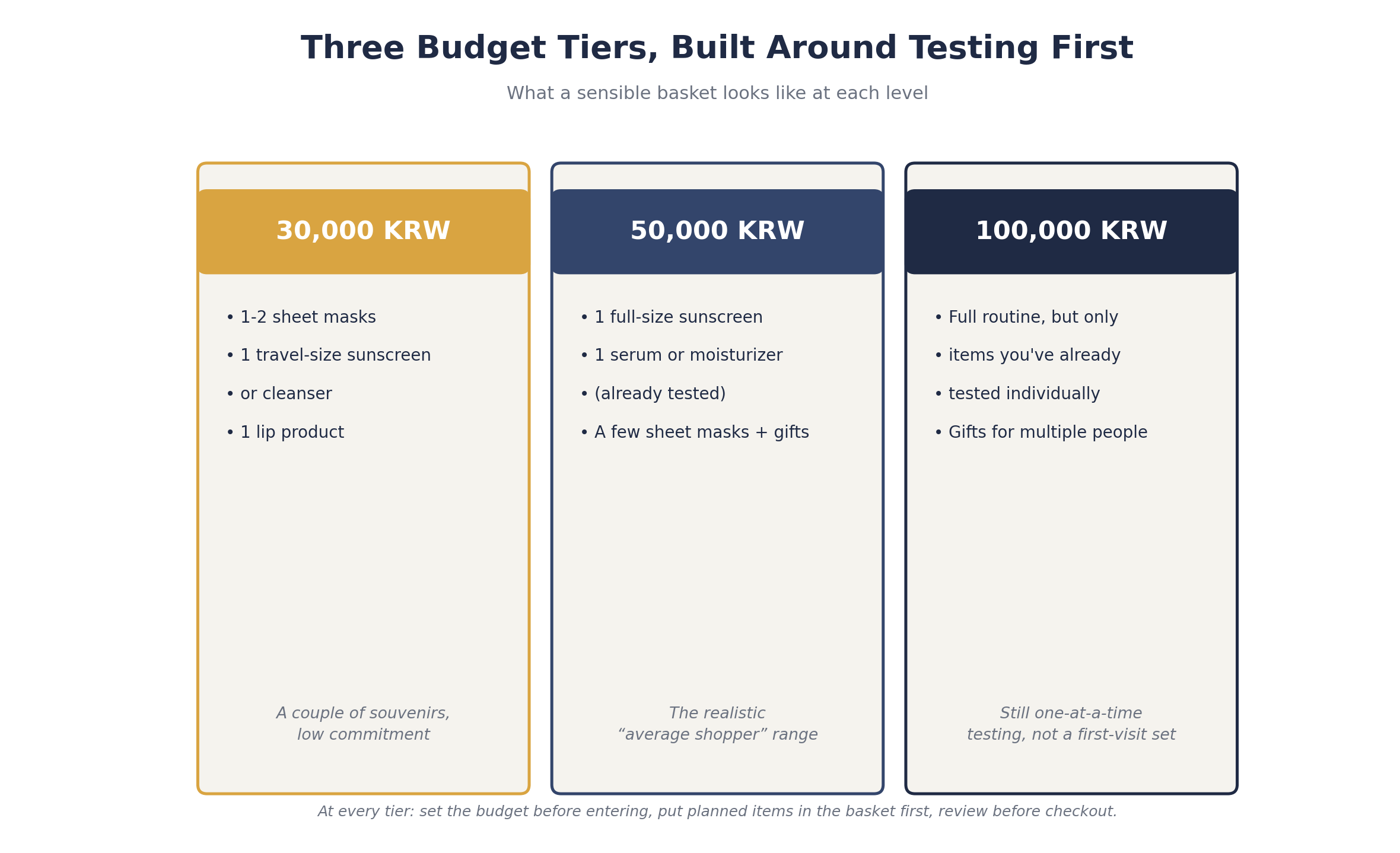
Three realistic budget levels, all built around testing before committing to more.
A few products rarely feel expensive individually — a sunscreen here, a serum there, a handful of sheet masks. The total at checkout is where the surprise usually happens. Setting a rough budget before you walk in, and reviewing your basket against it before paying, prevents most of that.
● 30,000 KRW: enough for 1-2 sheet masks, a travel-size sunscreen or cleanser, and a lip product — a couple of low-commitment souvenirs.
● 50,000 KRW: a full-size sunscreen, one serum or moisturizer (ideally something already tested), a few sheet masks, and small gifts — the realistic range for most travelers.
● 100,000 KRW: a fuller routine, but still built one tested item at a time rather than bought as a single first-visit set, plus gifts for multiple people.
At every level, the habit that matters most is the same one from earlier: basket the planned items first, browse after, and review the total before paying — not after.
Common Mistakes
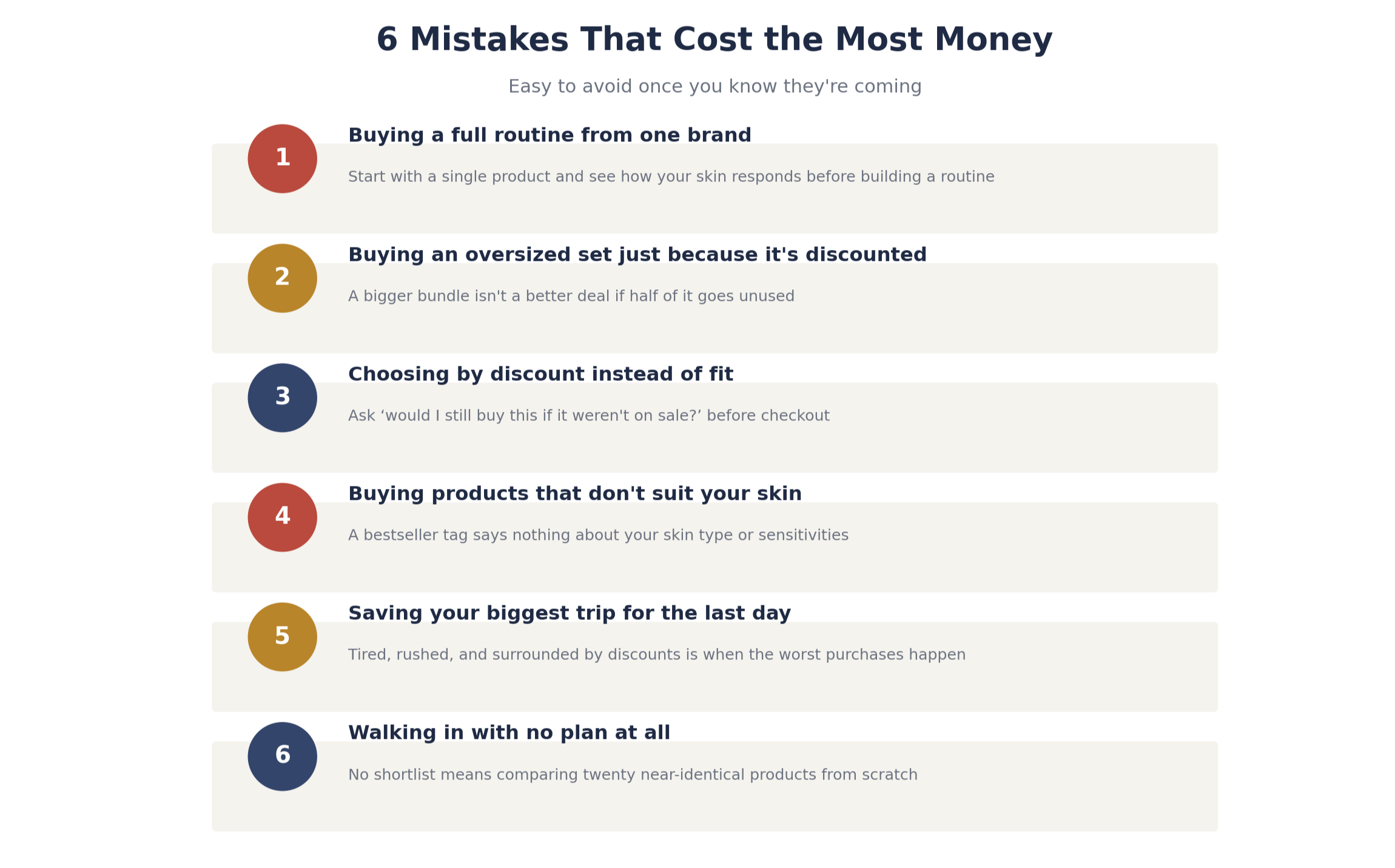
Six mistakes that account for most of the wasted money tourists report after an Olive Young trip.
● Buying a full routine from one brand on the first visit: start with a single product and see how your skin responds before committing to a toner, serum, cream, and sunscreen all at once.
● Buying an oversized promotional set because it's discounted: a bigger bundle isn't a better deal if half of it never gets used.
● Choosing by discount instead of fit: a discount should reduce the cost of something you already planned to buy, not justify buying something you didn't need.
● Buying products that don't suit your skin: a bestseller tag says nothing about your specific skin type, sensitivities, or how a product will actually feel after repeated use.
● Saving your biggest shopping trip for the last day: tired, rushed, and thinking about packing is exactly when impulse purchases multiply.
● Walking in with no plan at all: without even a rough shortlist, you're comparing twenty near-identical products cold, under time pressure, surrounded by promotions.
Shopping Checklist
Before Visiting
☐ Choose one product category and shortlist it to 2-3 candidates the night before
☐ Save screenshots of specific products rather than trying to remember long names
☐ Set a rough budget for the visit
☐ Leave room in your suitcase before buying anything large
☐ Bring your passport if you plan to use tax-free purchasing
While Shopping
☐ Check the promotion section before wandering the rest of the store
☐ Put planned purchases in the basket first, then browse
☐ Use testers when available, especially for cushion, sunscreen, and fragrance
☐ Confirm tax refund eligibility before paying, not after
Before Checkout
☐ Review your basket and remove anything you didn't originally plan to buy
☐ Ask ‘would I still buy this without the discount?’ for anything added on impulse
☐ Keep every receipt until you leave Korea
Before Flying Home
☐ Check your luggage weight before your final Olive Young run, not after
☐ Pack liquids and creams carefully — bag them separately in case of leaks during the flight
☐ Keep tax-refund receipts and paperwork accessible, not buried at the bottom of your suitcase
Tax Refund, Briefly
Ask about tax-free eligibility before you pay, not after — it's the easiest savings most tourists forget to use, and it's much simpler to sort out inside the store than at the airport later. For the full step-by-step process, see the Korea Tax Refund Guide.
FAQ
Should I trust Olive Young reviews on their own?
For most products, yes — they're the most relevant and accessible source. Switch the sort to “Newest” rather than reading only the top “Recommended” reviews, and check a few low-rated ones for repeated complaints.
How much should I trust Reddit reviews?
Reddit is a strong second opinion, especially for questions Olive Young reviews won't answer well — how a product performs outside Korea, in a different climate, or over long-term repeated use. It's less useful for very niche or newly released products with few discussion threads.
Can I test products in the store?
Many branches have testers available, particularly for cushion foundation, sunscreen finish, and fragranced products. Use them whenever you can, especially for anything where shade or texture matters.
Does a bestseller tag mean a product is actually good?
It means a lot of people bought it — nothing more. It doesn't tell you whether it suits your skin type, whether you'll like the texture, or whether you'll want to use it daily. Treat bestseller tags as a starting point for research, not a reason to buy.
How much should I buy on my first visit?
Less than it feels like you should. One sunscreen, one moisturizer or serum, and a sheet mask or two is enough for a first visit. Most travelers pass multiple Olive Young locations during a trip, so there's no need to make every purchase decision on day one.
When are Olive Young's sales?
A recurring “Olive Young Day” promotion runs around the 25th-27th of every month, and larger seasonal “Big Sale” events typically run for about a week each quarter (roughly March, June, September, and December). Outside of those dates, sale tags, 1+1, and 2+1 promotions are still common — you rarely need to time a visit around a specific sale.
Final Thoughts
The travelers who enjoy Olive Young the most usually aren't the ones who buy the most — they're the ones who arrive with a short list, test before they commit, and treat a discount as a bonus rather than a reason to buy.
A little research the night before, a budget you actually stick to, and a habit of buying one item before buying five of it will save more money than chasing any specific sale date. You'll likely leave with fewer products than you imagined walking in — and far fewer regrets.
Related Guides
- Korea Tax Refund Guide: 7 Common Mistakes First-Time Visitors Make
- How Much Cash Do You Need in Korea?
- Foreign Credit Cards Rejected in Korea
- Korean ATM Guide for Foreign Tourists: Global ATMs, Fees and Exchange Rates
- Korea eSIM vs SIM Card vs WiFi Egg: Which One Should You Use?
- Can Tourists Use Kakao T Without a Korean Phone Number? (2026 Incheon Airport Guide)


